In industrial environments, automated machinery, robotic cells and production equipment can pose significant risks to workers. Moving parts, unexpected movements, flying debris and accidental access to hazardous areas are just some of the dangers that may extend beyond the machinery itself.
To reduce these risks, perimeter guarding systems help define hazardous areas and control access to them. Industrial safety fencing is a common solution for protecting workers while maintaining good visibility of production operations.
However, simply installing a safety fence does not guarantee a safe installation. Its location, design, access points and safety distances must be suited to the hazards present and actual working conditions.
How can you choose and install perimeter guarding that effectively protects workers without unnecessarily complicating daily operations?

Perimeter guarding consists of physical barriers designed to prevent or control access to hazardous areas. These systems help separate workers from dangerous machine movements and automated processes.
This type of guarding is commonly used around robotic cells, automated production lines, conveyors and equipment whose movements may extend beyond a single workstation.
Unlike a guard installed directly on a machine, perimeter guarding protects a larger work area. It can enclose several pieces of equipment while providing access points for operators, maintenance personnel and material handling operations.

Industrial mesh safety fencing is among the most widely used solutions.
Its modular design makes it easier to accommodate different industrial layouts while allowing operators to monitor equipment visually.
Before selecting a safety fence or determining where to install it, it is essential to understand the risks associated with the machinery and its operation. A robotic cell, for example, does not present hazards only in the immediate vicinity of the robot. Its entire operating range must be considered, including the tools it handles, the parts it transports and the movements that may occur during normal operation or in the event of a malfunction.
The same principle applies to conveyors, automated machinery and other industrial equipment. A risk assessment should consider accessible areas, hazardous movements, loading and unloading operations, and the interventions required during production. The goal is not simply to enclose a machine, but to prevent workers from reaching its hazardous areas.
A safety fence may be tall enough to prevent someone from climbing over it while still being installed too close to hazardous equipment. For example, a worker may be able to reach a moving component by extending a hand or arm through the openings in a mesh panel.
ISO 13857 establishes safety distances intended to prevent upper and lower limbs from reaching hazardous areas. These distances depend on several factors, including the height of the guard, the location of the hazard and the dimensions of the openings.
For instance, mesh fencing with relatively large openings generally needs to be installed farther from a hazardous area than guarding with smaller openings. Potential access over, under or around the guarding must also be considered.
The height of a safety fence and its distance from the equipment must therefore be determined together, based on the hazards and possible means of access.
For more information, visit our page on safety distances, which includes tables and illustrations based on the requirements of ISO 13857.
Not all industrial facilities face the same challenges. The choice of guarding must account for the hazards involved, production requirements and the environment in which it will be installed. Steel mesh safety fencing is commonly used around robotic cells and automated production lines. It provides a physical barrier while maintaining good visibility of the equipment.
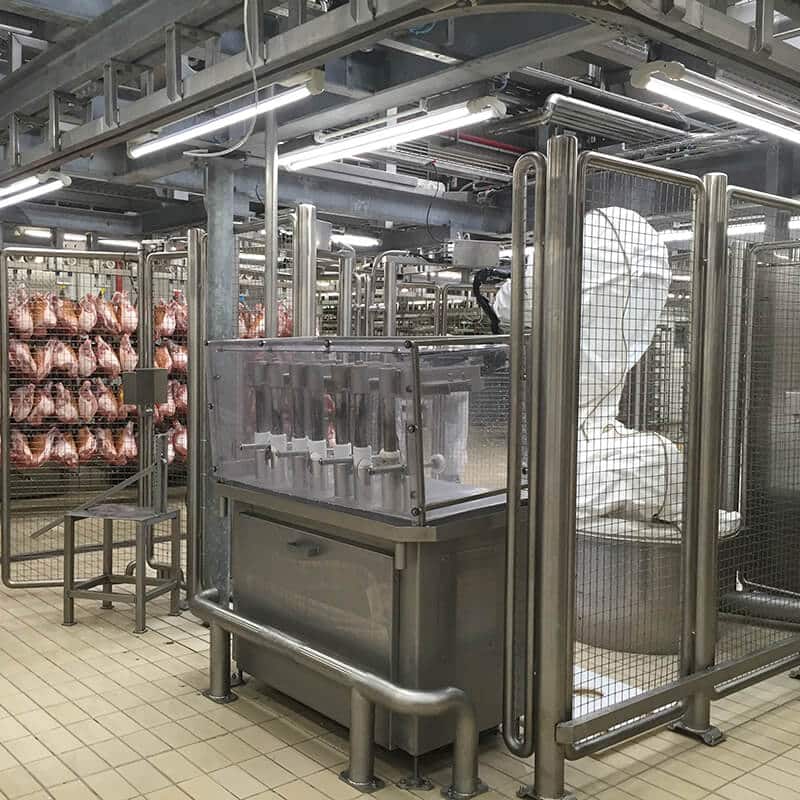
Other applications may require different types of protection. In the food processing and pharmaceutical industries, for example, stainless steel may be preferred because of its corrosion resistance and ease of cleaning.
Solid or transparent panels can also be used when protection against splashing liquids, flying chips or other materials is required. Some installations may instead require fully enclosed systems with sound insulation, ventilation or air conditioning, particularly when a process generates significant noise, heat or airborne contaminants.
Although mesh safety fencing may effectively prevent access to a hazardous area, it does not necessarily provide sufficient protection against flying debris, fumes or noise. This is why the choice of materials and guarding systems must always reflect the hazards present.

The strength of a guarding system depends on more than its mesh panels. Fixing brackets and posts also play an important role.
Depending on its location, safety fencing may be exposed to equipment vibrations, accidental impacts or other mechanical stresses. Panels, posts and anchors must be selected accordingly.
ISO 14120 addresses general requirements for the design and construction of fixed and movable guards. A properly designed guarding system must also account for the possibility of unauthorized removal, bypassing or displacement.
Perimeter guarding must prevent hazardous access without unnecessarily complicating operators' work. Adjustments, tool changes, material handling and equipment maintenance should all be considered during the design stage.
Poorly positioned or difficult-to-use access points may encourage workers to bypass safety devices. The selection and placement of safety doors are therefore important for both worker safety and efficient operations.

Hinged doors are a common solution for personnel access to protected areas. Easy to operate, they are particularly suitable where sufficient space is available for the door to open fully without interfering with nearby traffic or operations.

Sliding doors are especially useful when space is limited or when a swing door would obstruct a walkway or work area. They can also accommodate wider openings, particularly for moving parts, materials or equipment.
In either case, the choice should consider how frequently access is required, traffic around the machinery and actual working conditions. Measures must also be provided to allow personnel to exit a protected area when entry into the enclosure is possible.
A safety door must not allow workers to access hazardous machine movements without appropriate protective measures being in place. For this reason, industrial enclosure doors are often equipped with interlocking devices. These devices can monitor whether a door is open or closed and prevent certain hazardous machine functions while the door is open.
Consider a machine whose moving components continue rotating for several seconds after a stop command. Opening a safety door must not allow someone to reach those components before they have come to a complete stop. In such cases, a guard-locking device may be required to prevent the door from opening until the hazard has been eliminated. ISO 14119 establishes principles for the design and selection of interlocking devices associated with guards.
Depending on the risks involved, additional measures may also be necessary to prevent unexpected machine startup while someone is inside the protected area.
Even when properly installed, perimeter guarding does not necessarily address every hazard associated with a machine. It is an important preventive measure, but its effectiveness depends on how it is integrated into the overall machine safety strategy.
Consider a robotic cell surrounded by safety fencing. The enclosure may prevent workers from entering the hazardous area during normal operation.
However, when a technician needs to enter the enclosure, additional measures are required to prevent unexpected movements and control hazardous energy.

Depending on the installation, perimeter guarding may be complemented by machine-mounted safety guards, safety mats or safety light curtains.
Safety light curtains are particularly useful when frequent access to an area is required, provided their positioning and the machine's stopping time are sufficient to prevent a person from reaching the hazard.
Other protective measures may also be necessary depending on the risks involved, including appropriate ventilation, personal protective equipment and safe work procedures. Perimeter guarding should therefore be considered one part of a broader risk reduction strategy.
Before putting a perimeter guarding system into service, a few practical checks can help determine whether the installation addresses the hazards present and meets operational requirements.
1. Are hazardous areas truly inaccessible?
Check whether hazardous components can be reached through, over or under the mesh panels. Applicable safety distances must be respected, taking into account the dimensions of the openings and the location of the equipment.
2. Are access points suited to daily operations?
Doors should allow operators and maintenance personnel to perform adjustments, cleaning and maintenance without unnecessary obstacles. Poorly positioned or difficult-to-use access points may encourage workers to bypass safety devices.
3. Are openings and material transfer points properly safeguarded?
Gaps between panels, floor clearances and openings required for parts or conveyors must be examined. Even a small opening can present a risk if it allows someone to reach a hazardous area.
4. Is the guarding still appropriate for the equipment layout?
Adding a robot, relocating a machine or modifying a production process may make an existing guarding system inadequate. Any significant modification should therefore prompt a reassessment of the risks and protective measures.
Securing a hazardous area involves more than installing mesh panels around a machine. Safety distances, access points, interlocking devices and actual operating conditions must all be considered from the design stage. A well-designed guarding system helps reduce risks without unnecessarily interfering with production and equipment maintenance.
At Prismont, we offer industrial safety fencing solutions for machinery, robotic cells and automated production environments. Our team can also assist you with selecting and installing guarding solutions suited to your facility.
Planning a machine safeguarding project or looking to improve an existing installation? Contact our team to discuss your requirements.
References
CNESST and IRSST
CNESST
Exposition aux zones dangereuses d’une machine
Sécurité des machines : guide sur les protecteurs fixes et les distances de sécurité (PDF)
INRS
Sécurité des équipements de travail – Prévention des risques mécaniques (ED 6122)
Aide à la détection des risques liés à l'utilisation d'une machine (PDF)
Conception des machines : la démarche de conception
ISO
ISO 14120 – Safety of Machinery: Guards
ISO 13855 – Positioning of Safeguards
ISO 14119:2024 – Interlocking Devices Associated With Guards